
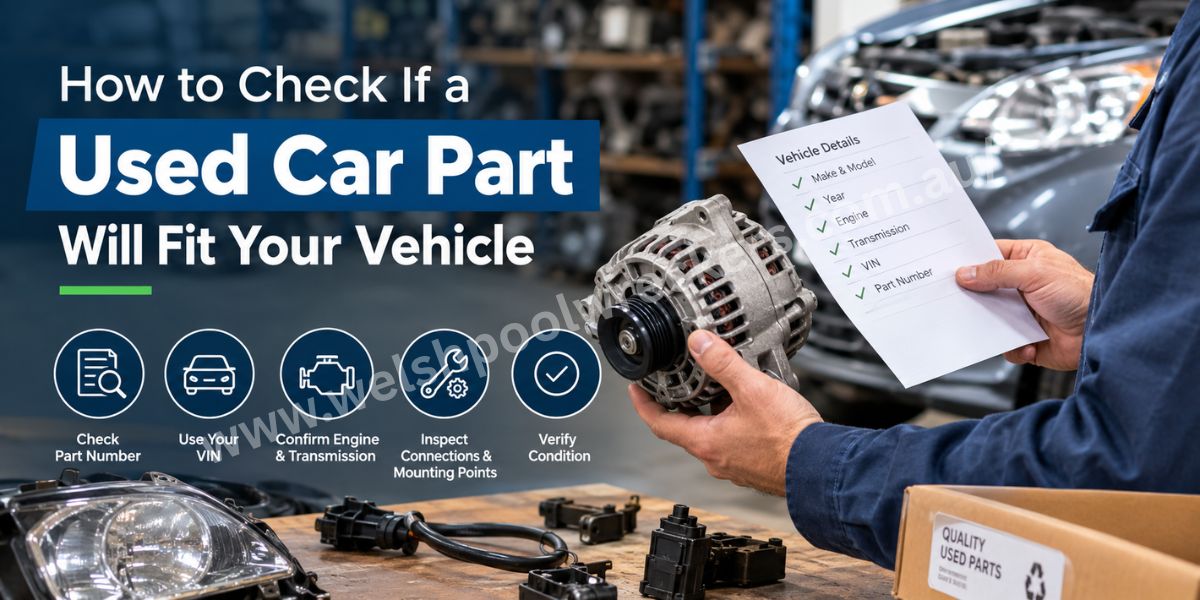
How to Check If a Used Car Part Will Fit Your Vehicle?
Finding a replacement car part is not always as simple as matching the shape or appearance. Two parts can look almost identical but have different connectors, mounting points or specifications. Installing the wrong component can waste time and money, and in some cases, it can create further problems with the vehicle.
Before buying a replacement component, it is worth checking a few important details. You do not need to be a mechanic to do the basic checks. Having accurate vehicle information and knowing what to look for can make the process much easier.
Start With Your Vehicle Details
Begin with the exact details of your vehicle. The make and model are useful, but they may not provide enough information on their own.
Try to have these details available:
- Make and model
- Model year
- Engine size and type
- Transmission type
- Body style
- Vehicle Identification Number (VIN)
A vehicle model can have several versions, and parts may vary between them. For example, the same model could be available with different engines or transmissions.
Giving the complete vehicle details helps a parts supplier identify the correct component rather than relying on the model name alone.
Find the Part Number
The part number is one of the most useful things to check before buying a replacement.
Depending on the component, the number may be printed on a label, stamped into the housing or marked on another section of the part. Compare this number with the replacement component where possible.
A matching number can be a strong indication that the component is correct, but it should still be confirmed. Manufacturers sometimes replace an older number with a newer or superseded number.
If you cannot tell whether two numbers are related, ask the supplier to check them before you purchase.
Use the VIN for More Accurate Matching
Your Vehicle Identification Number can provide more specific information about your vehicle than the make, model and year alone.
This can be particularly helpful when a vehicle was produced with different engines, transmissions or specifications.
The VIN can usually be found on the vehicle and in its registration or other vehicle documents.
When looking for an important mechanical or electrical component, providing the VIN can help a parts specialist narrow down the correct application.
Do Not Judge a Part by Its Appearance
One of the easiest mistakes to make is assuming a component will fit because it looks the same as the original.
A headlight, mirror, bumper, electrical component or other part can have a similar appearance while having different mounting points or connections.
Before buying, compare:
- Mounting holes
- Brackets
- Electrical connectors
- Bolt locations
- Sensor positions
- Hose connections
- Overall dimensions
- Part numbers
A photograph is useful for comparison, but appearance alone should not be used to confirm compatibility.
Check the Model Year
Model-year changes can affect parts compatibility.
Manufacturers may update components during a model’s production period. Changes can occur between model years or as part of a facelift.
Exterior components such as headlights, bumpers and tail lights can change, while electrical and mechanical components may also be updated.
For this reason, give the exact model year when asking about a replacement part. Avoid relying only on the vehicle’s model name.
Check the Engine and Transmission
The engine and transmission can make a significant difference when matching mechanical components.
A vehicle may have been available with several engine options, and each version may use different components. Transmission variations can also affect which parts are suitable.
Extra care is needed when sourcing components such as:
- Engines
- Gearboxes
- Alternators
- Starters
- Radiators
- Driveshafts
- Exhaust components
- Electronic modules
For larger mechanical components, provide the engine code or transmission details if you have them.
Check Which Side the Part Belongs To
Some components are made specifically for the left or right side of a vehicle.
This is common with:
- Side mirrors
- Headlights
- Tail lights
- Doors
- Body panels
- Some suspension components
Always confirm the side before purchasing. If there is any confusion, send a photo or ask the supplier to confirm the application.
Look at the Condition as Well
Finding a component that fits does not automatically mean it is the right choice.
The condition of the replacement should also be considered. Ask whether it has been inspected or tested where appropriate.
For body panels, look for dents, cracks, rust and signs of previous repairs. For mechanical components, ask about their condition and, where available, their history.
When buying from experienced Car wreckers, it can also be useful to ask which vehicle the component came from and whether it has been checked before being offered for sale.
Take Clear Photos of Your Existing Part
If you are unsure which component you need, photographs can help with identification.
Take pictures from several angles and include:
- The complete part
- Any part number or label
- Electrical connections
- Mounting points
- Brackets
- Nearby components
- Any identifying marks
Clear photographs give a supplier more information to work with.
However, photos work best when combined with your vehicle’s make, model, year and other specifications.
Ask Before You Buy
If you are not completely certain that a replacement component will fit, ask before making the purchase.
Provide the supplier with as much information as possible, including your vehicle details, VIN, original part number and photographs.
This allows the supplier to compare the information against their stock and identify a suitable component.
It is much easier to resolve a compatibility question before buying than after the part has been installed.
Buying Used Auto Parts in Perth
When searching for Used Auto Parts in Perth, having the right information ready can make the process quicker and more straightforward.
Instead of only providing the vehicle model, give the exact year, engine details and VIN where possible. If you have the original part number, include that as well.
You can also provide photographs of the existing component if you are unsure about its exact name or specification.
This information helps the supplier understand exactly what you need and reduces the chance of choosing an unsuitable part.
What If the Part Does Not Match?
Sometimes a component may appear suitable but turn out to be different once it is compared with the original.
If you notice a problem before installation, contact the supplier promptly and explain the difference.
It is also a good idea to understand the supplier’s return or exchange conditions before purchasing. Policies can vary depending on the type of component and its condition.
For some parts, installation, modification or damage after purchase may affect whether they can be returned. Knowing the conditions beforehand can help avoid unnecessary problems.
A Simple Compatibility Checklist
Before purchasing a replacement part, check:
- Make and model
- Exact model year
- Engine type or code
- Transmission
- VIN
- Original part number
- Mounting points and connectors
- Left- or right-side application
- Condition of the replacement
- Return or exchange conditions
You do not need specialist knowledge to start this process. The important thing is to collect accurate information and avoid making assumptions based only on appearance.
Make Sure You Get the Right Part
Choosing a replacement component should involve more than finding one that looks similar or has the right price.
Check the vehicle details, compare the part number, consider the engine and transmission, and use the VIN where possible. Photos and measurements can provide additional information when there is uncertainty.
Taking a few extra minutes to confirm compatibility can save you the inconvenience of buying the wrong component and discovering the problem later.
A careful approach makes it easier to find a suitable replacement and can make the entire repair process simpler and more cost-effective.
Recent Posts
-
How to Check If a Used Car Part Will Fit Your Vehicle?25 Sep 2026
-
What Affects a Cash Offer for an Unwanted Car?25 Aug 2026
-
Top Holden Parts Still in Demand After Production Ended08 Jun 2026
-
Why Perth Car Owners Prefer Professional Car Wreckers?19 May 2026
-
Which Car Parts Are Worth Selling Separately?17 Apr 2026
Categories
- Automotive (29)
- Uncategorized (1)